The Air We Breathe: Pollution, Public Health, and the Electric Revolution in Fuel Delivery
Explore how air pollution affects public health and how electric vehicle adoption in fuel delivery is creating a cleaner, healthier future for cities worldwide.
The Air We Breathe: Pollution, Public Health, and the Electric Revolution in Fuel Delivery
Every year, the World Health Organization estimates that outdoor air pollution kills approximately 4.2 million people worldwide. It is a number that belongs beside statistics on cancer, heart disease, and infectious illness, because that is precisely where air pollution sits in the global ledger of preventable death. Yet unlike a pathogen or a genetic risk factor, the primary sources of urban air pollution are machines we built, fuels we burn, and systems we designed. That means we can also redesign them.
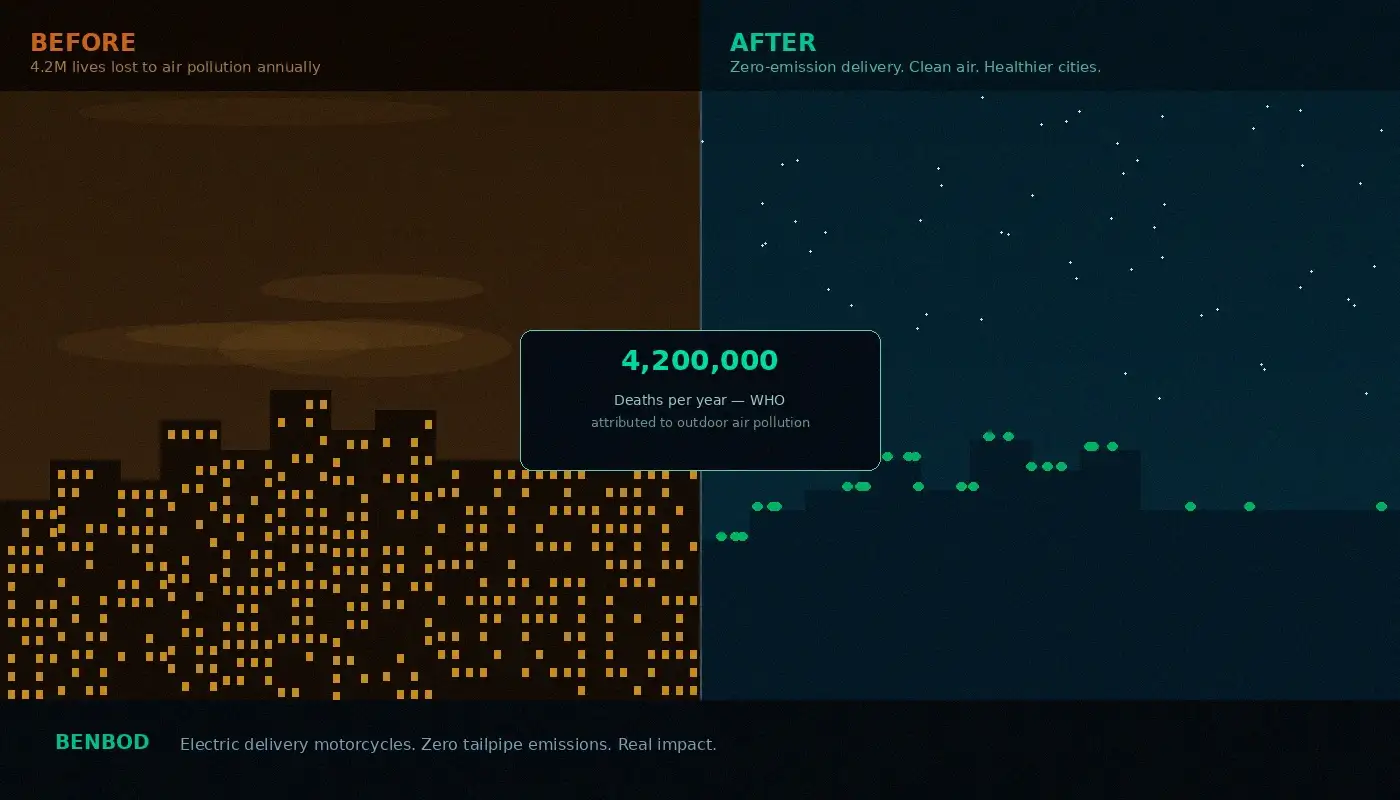
The transportation sector is the single largest contributor to urban air pollution in most major cities globally, accounting for between 40 and 70 percent of ground-level particulate matter and nitrogen oxide emissions in dense metropolitan areas, according to data from the International Energy Agency. Addressing that contribution requires two parallel shifts: electrifying the vehicles that move people and goods, and rethinking the support infrastructure that keeps those vehicles running.
The True Cost of Tailpipe Emissions
The harm caused by vehicle emissions is not abstract. Particulate matter smaller than 2.5 micrometers, the size fraction most associated with combustion engines, penetrates deep into lung tissue and crosses into the bloodstream, contributing to cardiovascular disease, respiratory illness, and cognitive decline. Long-term exposure is associated with increased rates of stroke, lung cancer, and premature births. Children living near high-traffic corridors show measurably lower lung development by the age of ten compared to children in cleaner environments.
Economic modeling by the OECD has placed the cost of air pollution in OECD member countries alone at over 1.7 trillion USD per year in health expenditure and lost productivity. In emerging economies, where vehicle fleets are older and emissions standards weaker, the per-capita burden is often higher. The data is consistent and unambiguous: the way we currently fuel and operate internal combustion vehicles is imposing an enormous cost on public health that is not reflected in the price at the pump.
Electric Vehicles and the Measurement of Progress
The shift toward electric vehicles represents the most significant transformation in personal and commercial transportation since the mass production of the internal combustion engine. Battery electric vehicles produce zero direct tailpipe emissions. Even when the electricity used to charge them is generated from fossil fuels, lifecycle analysis consistently shows that EVs produce 50 to 70 percent fewer carbon-equivalent emissions than comparable gasoline-powered vehicles, a gap that widens as the grid becomes cleaner.
In urban environments, where the health burden of vehicle emissions is most concentrated, the benefit of EV adoption is even more direct. A city in which 30 percent of its vehicle fleet is electrified does not just reduce emissions by 30 percent; it reduces concentrations of the specific pollutants most responsible for respiratory and cardiovascular harm at the street level, where people actually breathe.
Global EV sales passed 10 million units for the first time in 2022 and continued to accelerate through 2023, with the International Energy Agency projecting that EVs could account for over 60 percent of new vehicle sales globally by 2030 under current policy trajectories. The infrastructure challenge, charging access, grid capacity, and range anxiety, remains real. But the direction of travel is not in doubt.
The Overlooked Emissions: Fuel Logistics
A critical but frequently overlooked dimension of the transportation emissions problem is not the vehicles themselves but the infrastructure that supplies them. The traditional gas station model requires customers to drive to a fixed location to refuel. That refueling trip, however short, represents additional vehicle miles traveled, additional engine-on time, and additional emissions. In dense cities, where gas stations are often located on arterial roads with high ambient traffic, the clustering of refueling activity concentrates emissions in already-polluted corridors.
An on-demand fuel delivery model inverts this logic entirely. Instead of hundreds or thousands of individual vehicles making individual trips to a centralized station, a single optimized delivery unit brings fuel to multiple customers along a planned route. The aggregate vehicle miles associated with refueling decline significantly, and when the delivery fleet is itself electric, as BenBod's is, the operational emissions of the refueling activity approach zero.
BenBod's Electric Delivery as a Systemic Solution
BenBod operates its delivery fleet on electric motorcycles, a choice that is not merely cosmetic. Electric motorcycles generate no tailpipe emissions at the point of use, produce substantially lower noise pollution than petrol equivalents, and are ideally suited to urban environments where traffic density and stop-start driving cycles make internal combustion engines particularly inefficient and dirty.
The model creates a genuine reduction in the total emissions footprint of the refueling supply chain. Customers receive fuel without making an additional trip. The delivery unit follows a consolidated, algorithm-optimized route. The vehicle doing the delivering is itself emission-free at the point of operation. It is not a partial improvement on the existing model; it is a structural change that removes a significant source of unnecessary urban emissions from a supply chain that has never been designed with environmental impact in mind.
As governments accelerate emissions regulations, as cities impose low-emission zones, and as consumers increasingly factor environmental credentials into purchasing decisions, the businesses that will thrive are those that have already built clean operations into their foundations. BenBod's electric delivery model is not an adaptation to a changing regulatory environment. It is the right model for the environment that has always existed.
Join the electric revolution. Choose BenBod for cleaner, smarter fuel delivery.