From the First Pump to Your Driveway: A Century of Standing Still at the Gas Station
A historical journey through 119 years of gas station evolution, and how on-demand fuel delivery is finally disrupting an industry that has barely changed since 1905.
From the First Pump to Your Driveway: A Century of Standing Still at the Gas Station
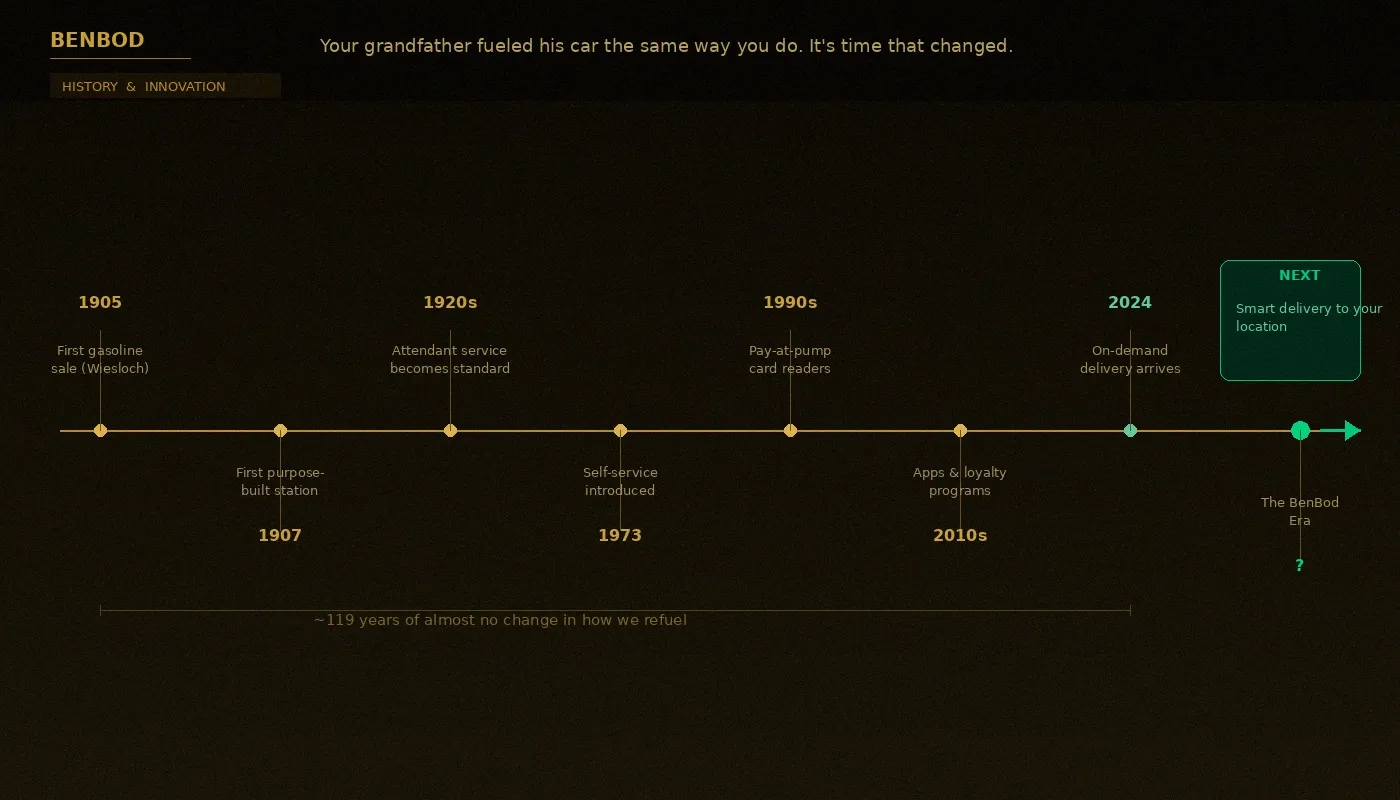
In 1905, a pharmacy in Wiesloch, Germany, sold gasoline from a cabinet-mounted tank to Bertha Benz, who was making history as the first person to complete a long-distance automobile journey. The fuel was dispensed by hand, the transaction was improvised, and the entire experience was a minor footnote in a much larger story about a technology that was about to reshape civilization. More than a century later, the basic act of refueling a car has changed less than almost any other common consumer experience. You still drive to a fixed location. You still stand beside your vehicle. You still hold a nozzle and wait.
That is a remarkable statement about the pace of change in an industry that sits at the intersection of one of the world's largest commodity markets and one of the most heavily engineered product categories in history. When almost everything else about modern life has been transformed beyond recognition, the gas station visit has endured, largely unchanged, as a ritual of the automobile age.
The Invention of the Service Station
The first purpose-built gasoline filling station is generally credited to Standard Oil of California, which opened a location in Seattle in 1907. Early stations were simple affairs: a pump, a hose, an attendant. Their primary innovation was consolidation, bringing fuel, which had previously been purchased in cans from hardware stores and pharmacies, to a dedicated, accessible location specifically designed for the automobile.
Through the 1920s and 1930s, the gas station evolved into a cultural institution. The attendant-service model, in which station employees pumped gas, checked oil, and washed windscreens, became standard across much of the developed world. Stations grew into architectural landmarks, with oil companies competing on the design and visibility of their forecourts. The experience was personal, often local, and tied to a specific relationship between driver and station.
Self-Service and the Long Plateau
The shift to self-service began in earnest in the United States in the 1970s, driven initially by the oil crisis of 1973 and the price pressures that followed. Removing the attendant reduced operating costs and allowed stations to compete more aggressively on fuel price. Within two decades, self-service had become the dominant model across most of the world, with a small number of countries, notably New Jersey in the United States and parts of Japan, retaining mandatory attendant service by law.
Self-service was, in many respects, the last major structural change to the gas station model. The introduction of pay-at-pump card readers in the 1990s eliminated the need to enter a kiosk to complete a transaction. Digital displays replaced analog dials. Loyalty programs appeared. Convenience stores expanded and diversified. But the fundamental architecture of the transaction remained identical: the driver navigates to the station, stops, exits the vehicle, and performs a manual fueling operation.
Consider what that means across time. Your grandfather refueled his car in essentially the same way you refuel yours today. The car itself is almost unrecognizable by comparison: fuel injection replaced carburetors, electronic management systems replaced mechanical timing, satellite navigation replaced paper maps. But at the moment of refueling, the interface between driver, vehicle, and fuel supply has been frozen in the mid-twentieth century.
Why the Industry Moved So Slowly
The longevity of the gas station model is not entirely surprising when examined through the lens of capital economics. Fuel distribution infrastructure requires enormous fixed investment. Underground storage tanks, forecourt equipment, safety systems, and supply chain logistics represent sunk costs that create strong disincentives to structural change. An established operator has every reason to optimize within the existing model and limited incentive to disrupt it.
Regulatory frameworks have compounded this inertia. Fuel handling is subject to strict safety standards that, while entirely necessary, have historically been written around the assumption of fixed-location dispensing. The legal and insurance frameworks governing fuel transport and delivery at customer premises were underdeveloped, in part because no significant commercial constituency had previously pushed for their development.
The result was a stable, profitable, and utterly stagnant service model that persisted through the arrival of the internet, the smartphone, the sharing economy, and the rise of artificial intelligence, all without being meaningfully disrupted.
The Moment for Change Has Arrived
Several forces have now converged to make the disruption of the traditional fueling model not just possible but likely. Smartphone adoption has created universal access to location-aware ordering platforms. Advances in fuel-safe container technology and vehicle design have made mobile dispensing safer and more practical. Insurance and regulatory frameworks in multiple markets have been updated to accommodate on-demand fuel delivery. And perhaps most importantly, consumer expectations have been permanently reset by a decade of on-demand services that have demonstrated what modern logistics can achieve.
The question that drivers are beginning to ask is not whether on-demand fuel delivery is possible. Platforms in the United States, Europe, Australia, and parts of the Middle East have proven that it is. The question is why it took this long, and which operators will define what the service looks like at scale.
BenBod and the Next Chapter
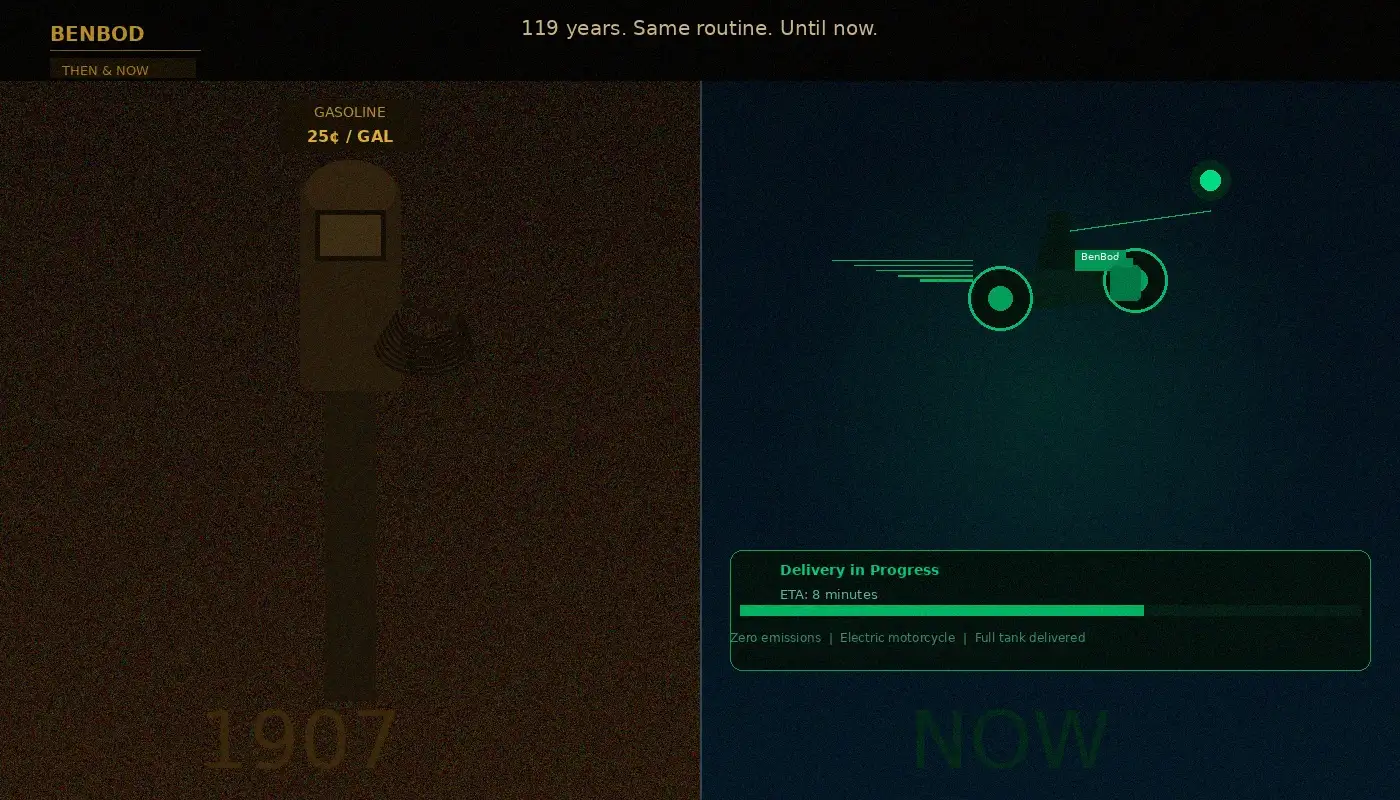
BenBod exists at the intersection of a century-old industry and the technology and logistical capabilities of the present moment. Its model, delivering fuel directly to the customer's location via a fleet of electric motorcycles coordinated through a smart dispatch platform, is the answer to a question the gas station was never designed to ask: what if the fuel came to you?
The history of the gas station is a history of convenience relative to what came before it. Compared to buying fuel in cans from a general store, a dedicated filling station was a revelation. Compared to leaving your vehicle and going inside to pay, paying at the pump was a meaningful improvement. Compared to driving to any fixed location and waiting to be served, on-demand delivery to your exact position is the same order of leap forward.
The first pump dispensed fuel to a traveler who had no alternative. The on-demand model offers an alternative to a ritual that the modern world has long outgrown. BenBod is not simply a fuel delivery company. It is the recognition that the story of how people access fuel does not have to end where it has been stuck for the past hundred years.
Join the revolution. Experience the future of fuel delivery with BenBod.