The On-Demand Era: How AI and Smart Delivery Are Rewriting the Rules of Modern Living
Explore how artificial intelligence, real-time logistics, and mobile connectivity are transforming fuel delivery and modern urban living.
The On-Demand Era: How AI and Smart Delivery Are Rewriting the Rules of Modern Living
We live in a world where a single tap on a smartphone can summon a car, deliver restaurant meals, or dispatch a plumber within the hour. Artificial intelligence, real-time logistics, and mobile connectivity have collapsed the distance between want and receive. Yet, one of the most fundamental needs of modern life has remained stubbornly old-fashioned: refueling your vehicle still means pulling off the road, waiting in line, and spending time at a gas station built on a model that has barely changed in a century.
That gap is closing. And the companies leading the change are not the oil majors or the legacy station chains. They are lean, technology-driven platforms that are applying the same principles that transformed food delivery, ride-hailing, and e-commerce to the business of putting fuel in your tank.
The Architecture of the On-Demand Economy
The on-demand economy runs on three interconnected pillars: real-time data, intelligent dispatch, and last-mile logistics. When you order food through a delivery app, algorithms are already calculating the nearest available courier, the optimal route, and the estimated preparation time at the restaurant, all before the kitchen has read the ticket. The same logic, applied to fuel, produces a service that can locate your vehicle, dispatch a delivery unit, and complete a fill-up while you work, shop, or sleep.
According to a 2023 report by McKinsey, on-demand service platforms in sectors ranging from healthcare to automotive support generated over 450 billion USD in global consumer spending, a figure projected to more than double by 2030. The common thread across every high-growth segment is the elimination of what economists call friction costs: the time, effort, and mental overhead consumers spend navigating tasks that technology can automate. Fuel delivery addresses one of the most universal friction costs in daily life.
Artificial Intelligence as the Dispatcher
Modern fuel delivery platforms depend on AI at every stage of the process. Route optimization algorithms, trained on traffic pattern data, weather feeds, and historical demand curves, allow a single fleet operator to serve far more customers per shift than traditional point-to-point logistics would permit. Predictive demand modeling identifies which neighborhoods will need fuel most on a given day, allowing inventory and fleet positioning to be calibrated in advance rather than reacting to orders after they arrive.
Customer-facing interfaces powered by machine learning can anticipate repeat orders, suggest optimal refueling schedules based on driving behavior, and integrate with connected vehicle platforms to trigger automatic requests when a tank drops below a certain threshold. The result is a service that increasingly feels effortless, because the cognitive work has been moved from the user to the algorithm.
Quality of Life at the Center
The case for on-demand fuel delivery is not purely logistical. It is fundamentally about the quality of daily life. Time is the scarcest resource in the modern urban experience. A commuter who refuels three times per month spends, on average, between 45 and 60 minutes per month at a gas station, accounting for detour, queue, and transaction time. Annualized across a working population, those minutes represent an enormous collective loss of productive and leisure time.
For specific populations, the convenience argument becomes even more compelling. Parents managing school runs and work schedules, elderly drivers for whom physical mobility is limited, delivery professionals whose income depends on maximum vehicle uptime, and businesses operating commercial fleets all have strong, practical reasons to eliminate the station stop from their routines.
BenBod and the Intelligent Delivery Standard
BenBod was built around a simple premise: fuel delivery should be as fast, clean, and reliable as any other modern logistics service. Operating through a platform that combines real-time mapping, intelligent order management, and a fleet of electric delivery motorcycles, BenBod brings certified, high-quality fuel directly to the customer's location, whether that is a home driveway, a corporate parking lot, or a roadside waiting point.
The company's approach reflects a broader truth about where the on-demand economy is heading. Services that once seemed impossible to deliver at the customer's location, medical consultations, grocery restocking, automotive servicing, are now table stakes. Fuel, the one consumable that almost every car owner has been conditioned to collect in person, is simply the next frontier.
The technology infrastructure already exists. The consumer demand is already proven. What on-demand fuel delivery required was an operator willing to build a platform that matches the standard consumers now expect from every other part of their lives. That is the promise BenBod is delivering on, one tank at a time.
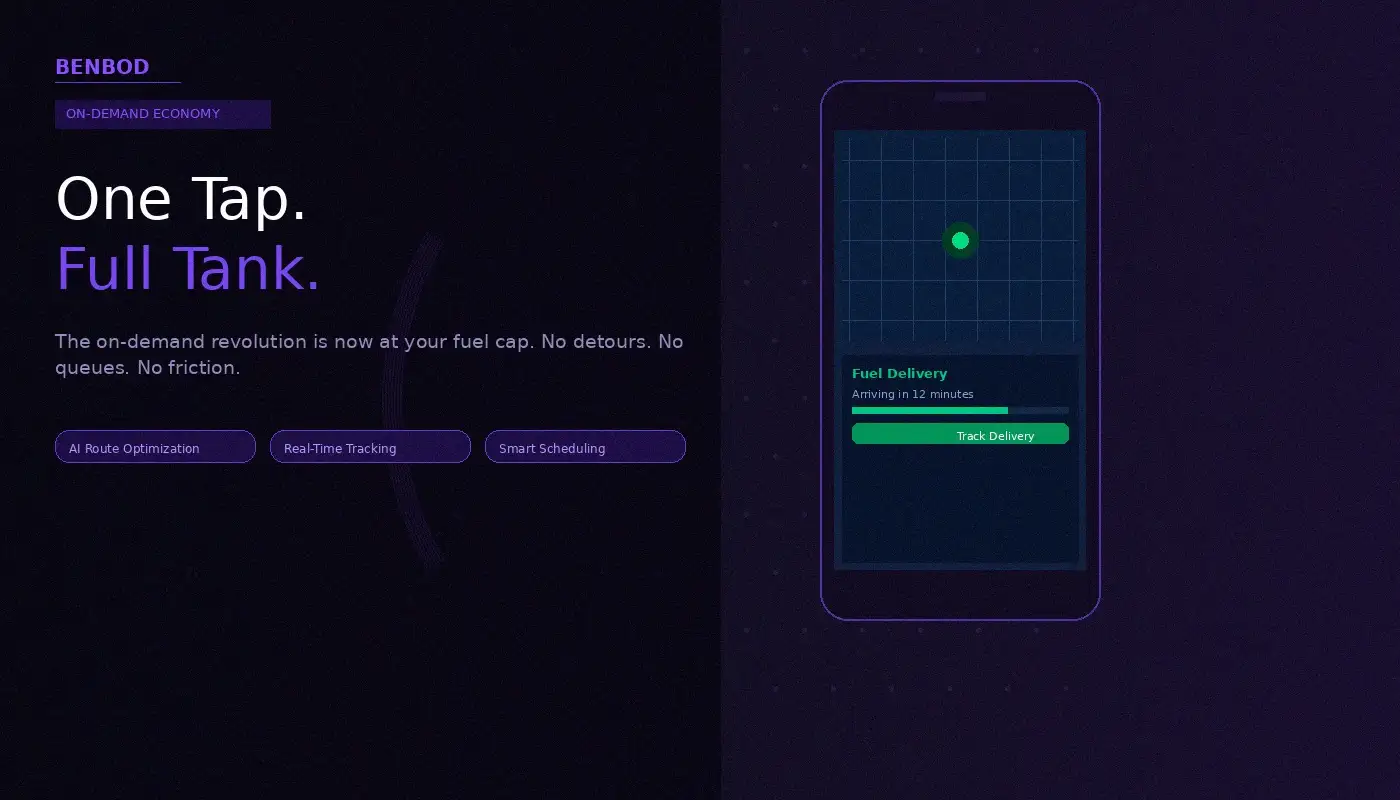
Experience the future of fuel delivery with BenBod. Download the app today.